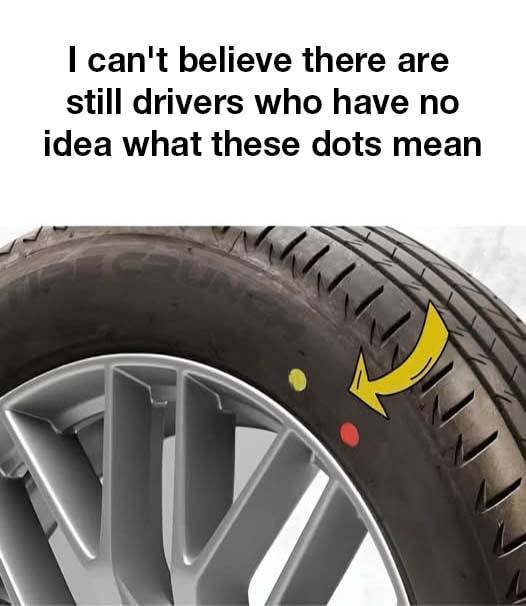
Here’s what they really mean:
🟡 Yellow Dot = Lightest Point of the Tire
The yellow dot marks the lightest spot on the tire.
👉 It should be aligned with:
-
The valve stem (which is typically the heaviest point of the wheel)
Why?
Matching the lightest part of the tire with the heaviest part of the wheel helps reduce how much balancing weight is needed.
🔴 Red Dot = Highest Point of Radial Runout
The red dot marks the highest point of the tire’s roundness variation (stiffest or most raised spot).
👉 It should be aligned with:
-
The wheel’s low point mark (if the wheel has one)
Some premium wheels have a small dimple indicating their lowest point. Matching high-to-low improves ride smoothness.
🤔 What If Both Dots Are Present?
General rule:
-
If the wheel has no mark → align the yellow dot with the valve stem.
-
If the wheel does have a low-point mark → align the red dot with that mark (ignore the yellow dot).
🚗 Do They Matter?
Yes — especially for:
-
High-speed driving
-
Performance vehicles
-
Minimizing vibration
-
Reducing balancing weights
If your installer ignores them, the tire can still be balanced — but it may require more weight.
If you’d like, tell me what vehicle the tires are for, and I can explain whether proper dot alignment is especially important in your case.